
COMPRESSION PRESSURE - Measurement of Compression Pressure
EM-73prose procedureCompression pressure differs between SR20DE and SR20DET.
Measurement of Compression Pressure
- 1Warm up engine.
- 2Turn ignition switch off.
- 3Release fuel pressure. Refer to "Releasing Fuel Pressure" in section EF & EC.
- 4Remove all spark plugs.
- 5Disconnect distributor center cable.
- 6Attach a compression tester to No. 1 cylinder.
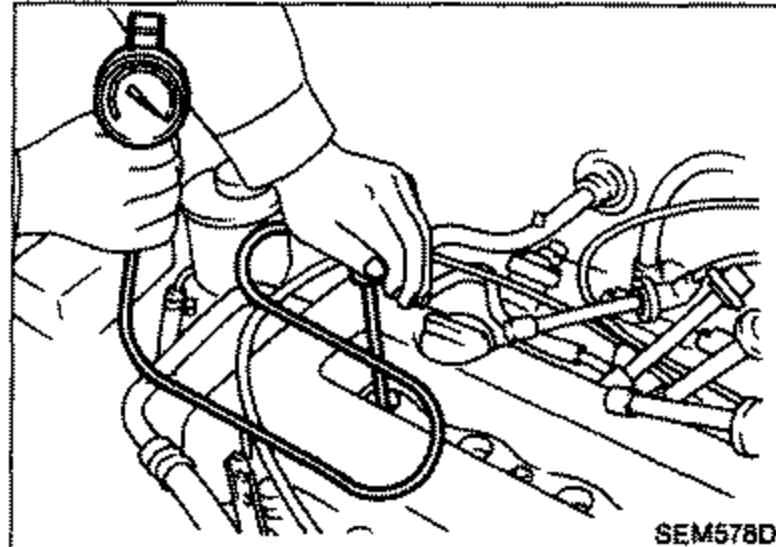 SEM578D
 - 7Depress accelerator pedal fully to keep throttle valve wide open.
- 8Crank engine and record highest gauge indication.
- 9Repeat the measurement on each cylinder as shown above.Always use a fully-charged battery to obtain specified engine revolution.
- 10If cylinder compression in one or more cylinders is low, pour a small amount of engine oil into cylinders through spark plug holes and retest compression.If adding oil helps compression, piston rings may be worn or damaged. If so, replace piston rings after checking piston.If pressure stays low, a valve may be sticking or seating improperly. Inspect and repair valve and valve seat. (Refer to S.D.S.) If valve or valve seat is damaged excessively, replace them.If compression in any two adjacent cylinders is low and if adding oil does not help compression, there is leakage past the gasket surface. If so, replace cylinder head gasket.
Compression pressure (Unit: kPa (bar, kg/cm², psi)/300 rpm)
Standard
SR20DE1,275 (12.75, 13.0, 185)
SR20DET1,128 (11.28, 11.5, 164)
Minimum
SR20DE1,079 (10.79, 11.0, 156)
SR20DET932 (9.32, 9.5, 135)
Difference limit between cylinders
SR20DE98 (0.98, 1.0, 14)
SR20DET98 (0.98, 1.0, 14)
See also
EF & EC (Releasing Fuel Pressure) · S.D.S.