
Engine Removal - Warning / Caution / Removal
EM-51prose procedureItem e (fuel pressure release) applies to GA16DE. Tie-rod ball joint disconnect applies to both R.H. & L.H.
WARNING
a. Situate vehicle on a flat and solid surface.
b. Place chocks at front and back of rear wheels.
c. Do not remove engine until exhaust system has completely cooled off. Otherwise, you may burn yourself and/or fire may break out in fuel line.
d. For safety during subsequent steps, the tension of wires should be slackened against the engine.
e. Before disconnecting fuel hose, release fuel pressure from fuel line. (GA16DE) Refer to "Releasing Fuel Pressure" in section EF & EC.
f. Be sure to hoist engine and transaxle in a safe manner.
g. For engines not equipped with engine slingers, attach proper slingers and bolts described in PARTS CATALOG.
CAUTION
When lifting engine, be careful not to strike adjacent parts, especially accelerator wire casing, brake lines, and brake master cylinder.
In hoisting the engine, always use engine slingers in a safe manner.
In removing drive shaft, be careful not to damage grease seal of transaxle.
IMPORTANT
Engine cannot be removed separately from transaxle. Remove engine with transaxle.
Removal
- 1Drain water.
- 2Remove hood.
- 3Remove battery.
- 4Remove reservoir tank and bracket.
- 5Remove drive belts.
- 6Remove alternator, compressor and power steering oil pump from engine.
- 7Remove the following parts: Right and left front tires; Under covers; Splash covers; Brake caliper assembly; Disconnect tie-rod ball joint (R.H. & L.H.).Brake caliper assembly tightening torque: 72 - 97 N·m (7.3 - 9.9 kg-m, 53 - 72 ft-lb)Brake hose does not need to be disconnected from brake caliper assembly. Never depress brake pedal.Tie-rod ball joint tightening torque: 29 - 39 N·m (3.0 - 4.0 kg-m, 22 - 29 ft-lb)
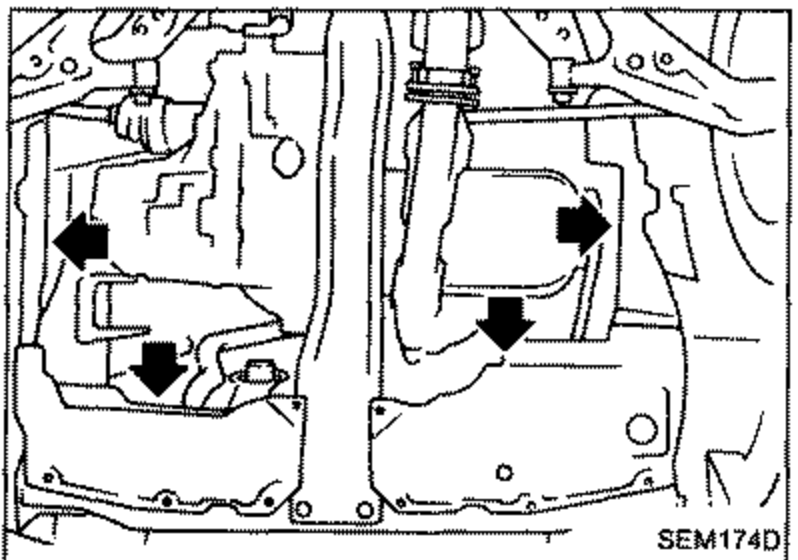 SEM174D
See also
Releasing Fuel Pressure (EF & EC) · PARTS CATALOG