
Engine Removal - Warning / Caution / Removal procedure
EM-138prose procedureStep distinctions for SR20DET (intercooler), 2WD vs 4WD (propeller shaft, clutch operating cylinder, center member vs front member, R.H. buffer).
WARNING
a. Situate vehicle on a flat and solid surface.
b. Place chocks at front and back of rear wheels.
c. Do not remove engine until exhaust system has completely cooled off. Otherwise, you may burn yourself and/or fire may break out in fuel line.
d. For safety during subsequent steps, the tension of wires should be slackened against the engine.
e. Before disconnecting fuel hose, release fuel pressure from fuel line. Refer to "Releasing Fuel Pressure" in section EF & EC.
f. Be sure to hoist engine and transaxle in a safe manner.
g. For engines not equipped with engine slingers, attach proper slingers and bolts described in PARTS CATALOG.
CAUTION
When lifting engine, be careful not to strike adjacent parts, especially accelerator wire casing, brake lines, and brake master cylinder.
In hoisting the engine, always use engine slingers in a safe manner.
Removal
- 1Remove engine under cover and hood.
- 2Drain coolant from both cylinder block, and radiator.
- 3Remove intercooler. (SR20DET only)
- 4Remove vacuum hoses, fuel hoses, wires, harness and connectors and so on.
- 5Remove exhaust tubes, ball joints and drive shafts.
- 6Remove propeller shaft. (4WD models only)
- 7Remove clutch operating cylinder. (4WD models only)
- 8Remove radiator and fans.
- 9Remove drive belts.
- 10Remove alternator, compressor and power steering oil pump from engine.
- 11Set a suitable transmission jack under transaxle. Hoist engine with engine slinger.
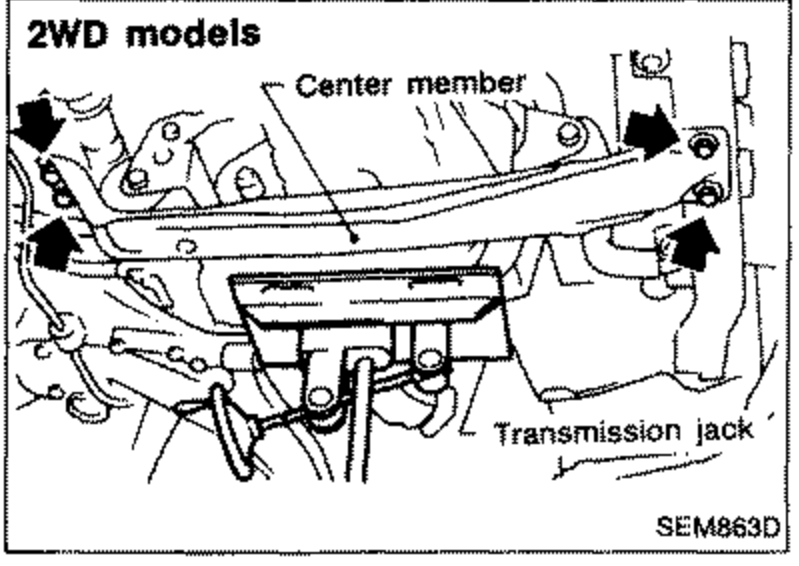 SEM863D
 - 122WD models: Remove center member. 4WD models: Remove front member.
- 13Remove R.H. buffer. (4WD models only)