
AUTOMATIC TEMPERATURE CONTROL (A.T.C.) AIR CLEANER SYSTEM
EF & EC-193prose procedureApplies to GA13DS, GA14DS & GA16DS.
Inspection (Cont'd)
Air Control Valve Inspection (continued)
- 3Start engine and immediately check the air control valve position. If it rises, it is correct.
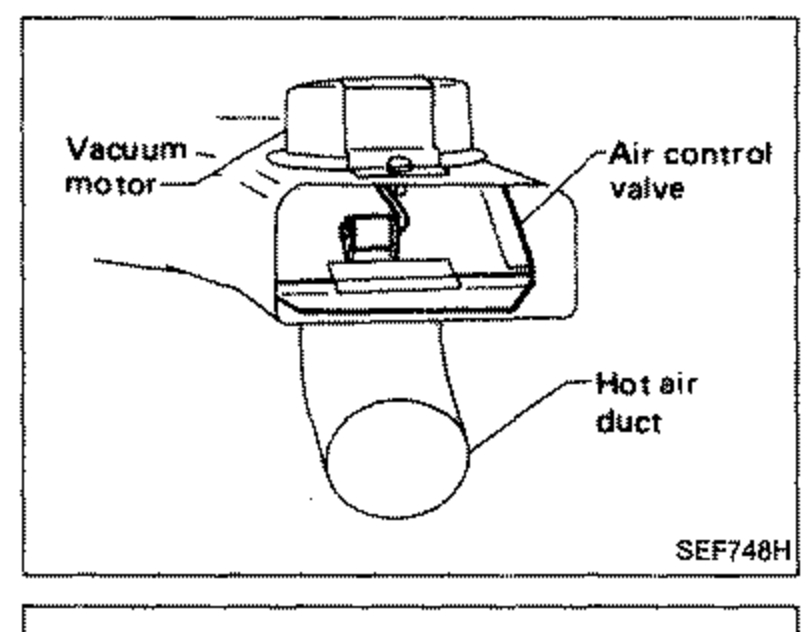 SEF748H
 - 4Make sure that air control valve moves up and down when engine speed is quickly increased and decreased.
- 5Make sure that air control valve partially rises when engine warm-up advances.
If the above test reveals any malfunction in the operation of the air control valve, carry out the following test:
Vacuum motor
Disconnect the inlet vacuum hose of vacuum motor, and connect another hose to the inlet to apply vacuum to vacuum motor. Then, confirm that air control valve moves.
| Specification | Value |
|---|---|
| Air control valve operating vacuum — Opening startsOpening starts | 6.7 ± 2.0-kPa (67 ± 20, 50 ± 15, 1.97 ± 0.59 -mbar, -mmHg, -inHg) |
| Air control valve operating vacuum — Full openingFull opening | 13.3 ± 3.3-kPa (133 ± 33, 100 ± 25, 3.94 ± 0.98 -mbar, -mmHg, -inHg) |
Air control valve operating vacuum — Opening startsOpening starts
6.7 ± 2.0-kPa (67 ± 20, 50 ± 15, 1.97 ± 0.59 -mbar, -mmHg, -inHg)
Air control valve operating vacuum — Full openingFull opening
13.3 ± 3.3-kPa (133 ± 33, 100 ± 25, 3.94 ± 0.98 -mbar, -mmHg, -inHg)
Temperature sensor
While engine is cool and idling, disconnect inlet vacuum hose of vacuum motor and make sure that intake manifold vacuum is present at the end of vacuum hose. If vacuum is weak or is nonexistent, check vacuum hose for leakage. Replace temperature sensor if vacuum hoses are in good condition. After engine warms up, make sure no vacuum exists. If necessary, replace temperature sensor.