
Engine Cooling System - Refilling Engine Coolant (Cont'd)
LC-5prose procedureAir-bleed procedure differs: GA and CD engines repeat steps 5-10; SR engine uses the transparent-hose sub-procedure (steps 1)-8)).
NOTE
GA, SR, CD
Refilling Engine Coolant (Cont'd)
- 12Install a proper radiator filler cap. (Original radiator filler cap)
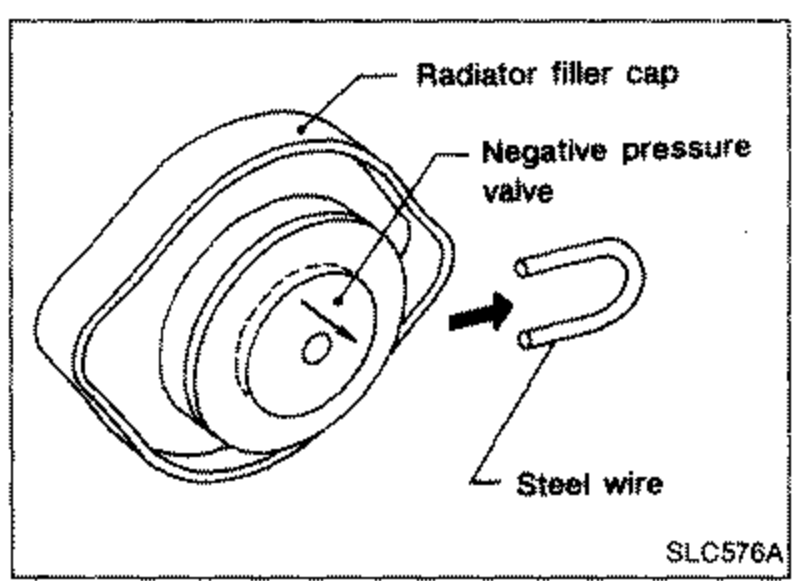 SLC576A
 - 13Warm up engine, and check for sound of coolant flow while running engine from idle up to 4,000 rpm with heater temperature control lever set at several positions between COOL and HOT.Sound may be noticeable at heater water cock.
- 14GA and CD engines: If sound is heard, bleed air from cooling system by repeating steps 5 through 10 until coolant level no longer drops. SR engine: If sound is heard, bleed air from cooling system according to the following steps.
- 1)Cool engine down and remove air bleeder cap on heater inlet hose.
- 2)Attach a suitable transparent hose at air bleeder pipe and put the opposite end of the hose into coolant of reservoir tank.
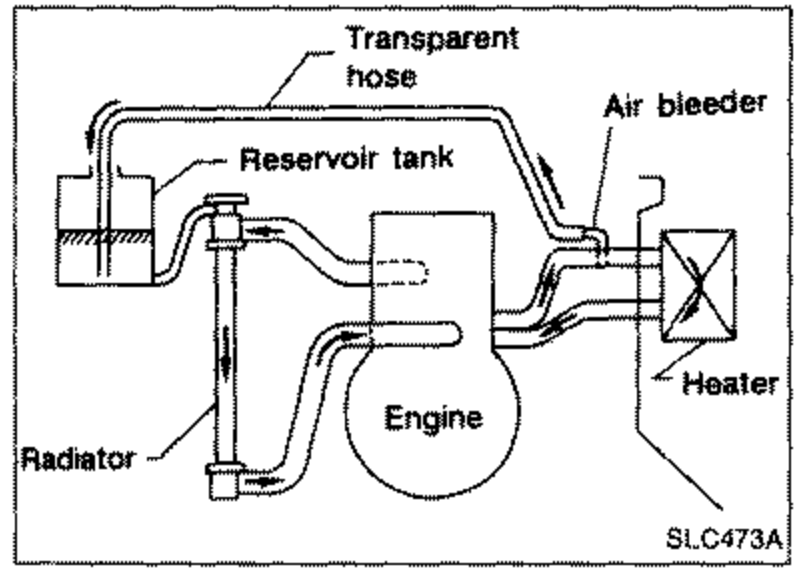 SLC473A
 - 3)Install the temporary radiator cap and check for proper connection of all coolant related hoses.
- 4)Start engine and check for bubbles in reservoir tank.
- 5)Set heater temperature control lever to max "COOL" position in order to bypass coolant through the transparent hose.
- 6)Run engine up to 2,300 rpm until bubbles disappear in the transparent hose.Do not run engine over 2,300 rpm because engine may be damaged due to reduced coolant flow.
- 7)After removing bubbles, set heater temperature control lever to max "HOT" position and check for sound of coolant flow.
- 8)If sound is heard, repeat step 5) through step 7).
- 15Stop engine and cool it down.
- 16Install a proper radiator cap. (Original radiator cap)
- 17Remove the transparent hose and install air bleeder cap.
- 18Check any removed parts for secure reinstallation.